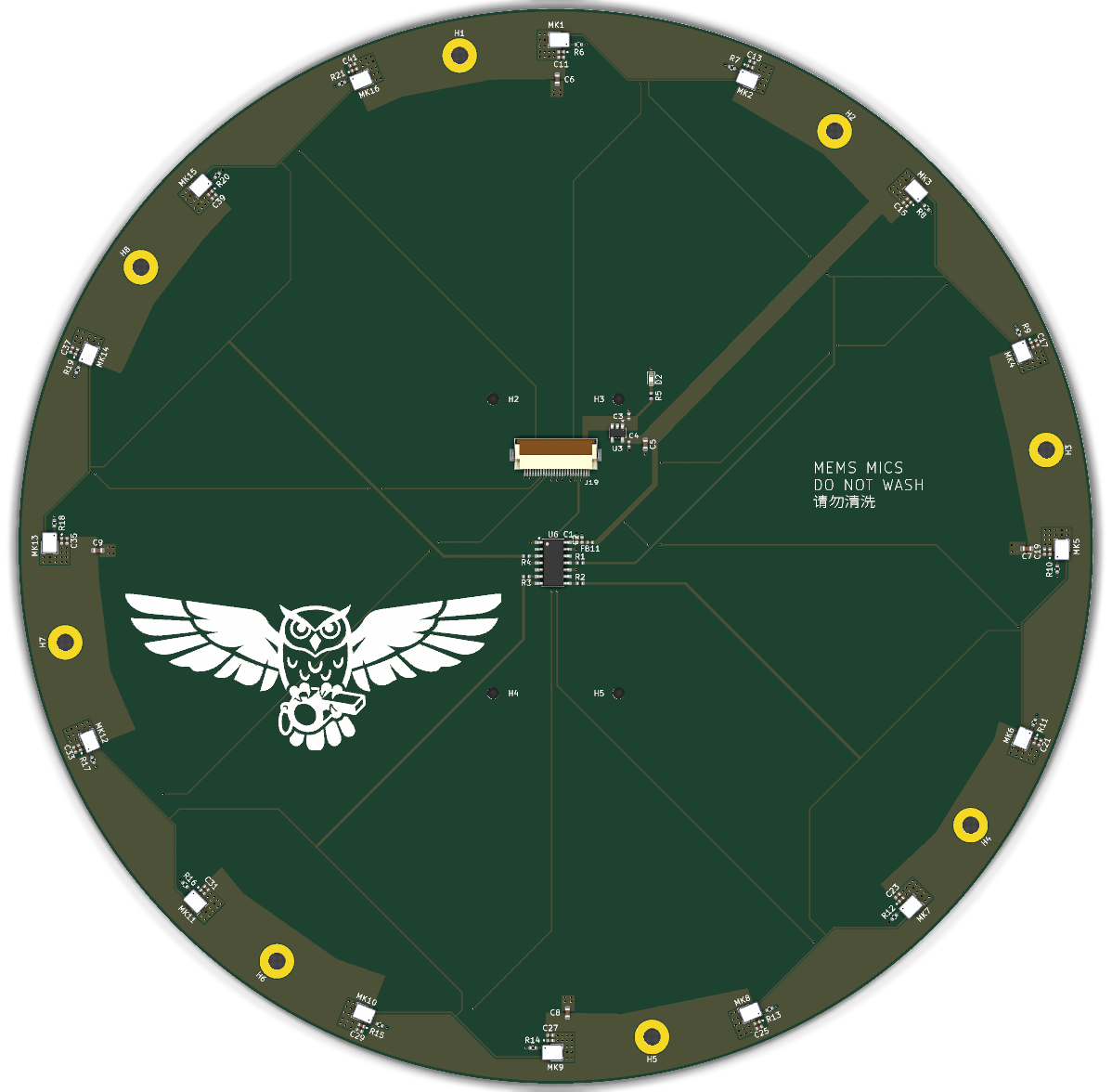
An open-source MEMS mic array and motherboard. Sixteen Infineon mics on a 188 mm ring feed an XMOS XU316, which streams all 16 channels over USB-C at 48 kHz as a standard USB audio device, so no driver is needed. The parts for one set cost $76.
Nov 2, 2026
Whistler is two boards: a round mic array and a small motherboard. Plugged in, it shows up as a 16-channel microphone called “Whistler 16ch Mic”, so anything that can record from a multichannel sound card can record all 16 mics.
The mic array is a 2-layer board, 200 mm across. Its 16 Infineon IM72D128 MEMS mics sit on a 188 mm circle, 36.7 mm apart. They run at 1.8 V with a 3.072 MHz PDM clock, and the datasheet rates them at 72 dB(A) SNR with a 128 dB SPL overload point. A 24-pin flat cable carries power, the PDM clock and eight data lines to the motherboard, with two mics sharing each data line.
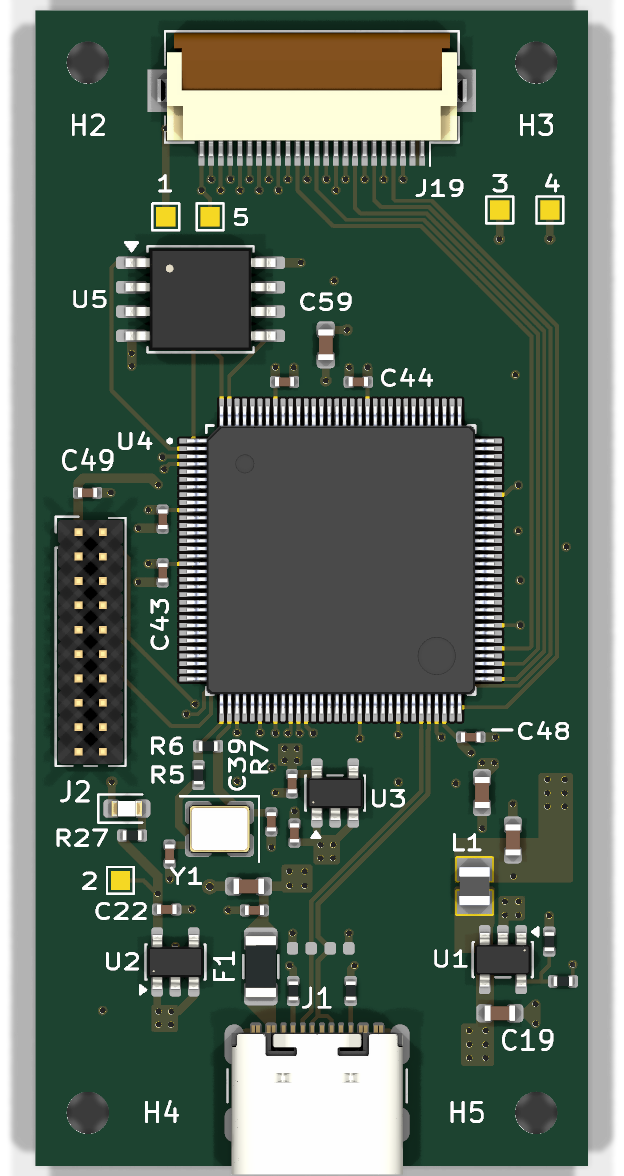
The motherboard is a 4-layer board, 28.8 × 60.2 mm, built around an XMOS XU316 from their xcore.ai family. The XU316 has 16 cores split across two tiles, 1 MB of RAM on the chip and its own USB 2.0 PHY, so USB runs straight from the connector to the processor with no separate USB chip. The firmware is XMOS’s mic_aggregator example with some changes. It drives the mic clock, splits the eight PDM lines into 16 channels, decimates them to 48 kHz in software and streams them over USB. The rest of the board is a 128 Mbit QSPI flash the XU316 boots from, a 24 MHz crystal, the power rails (0.9 V for the core from a buck converter, 1.8 V and 3.3 V from LDOs) and a header for the xTAG programmer that flashes a new board the first time. After that, updates are meant to go over USB, though that hasn’t been tested yet.
The mic spacing sets the useful band. Beamforming works from about 1 kHz up to 4.7 kHz. Above that the mics are too far apart for the wavelength and the beam picks up spatial aliasing.
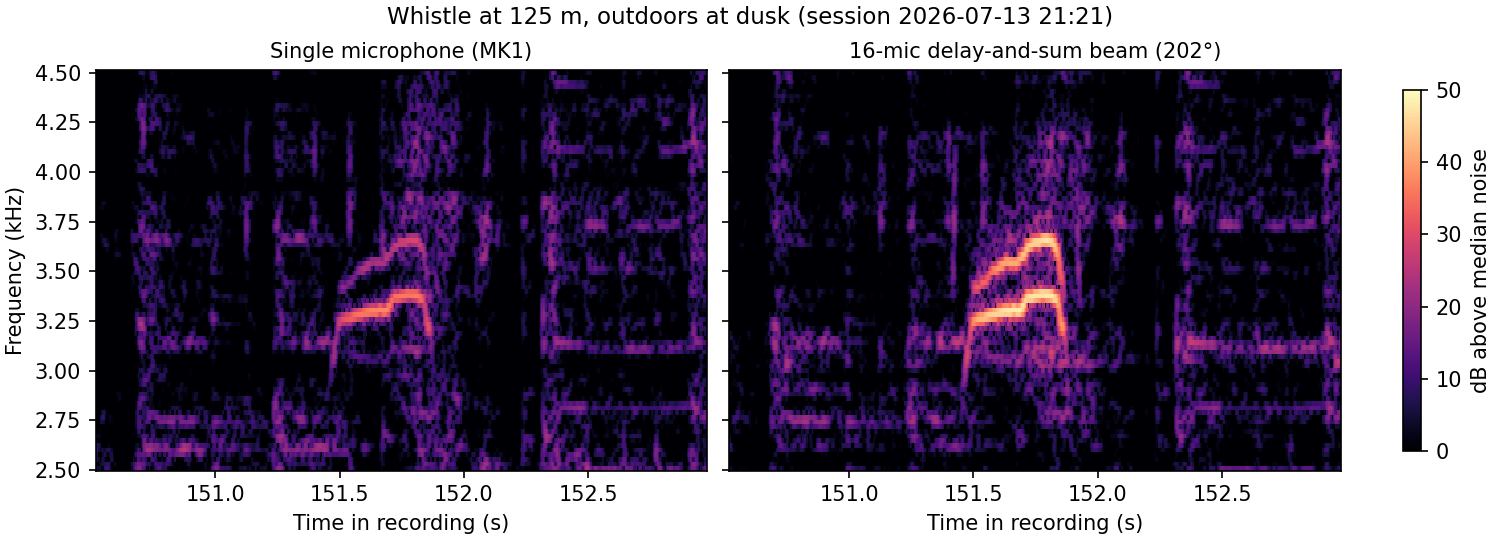
The main test was outdoors at dusk, with crickets and birds in the background. A whistle was blown 125 m from the array. On a single mic it came through at 39 dB SNR. With all 16 mics combined in a delay-and-sum beam pointed at it, it came through at 51 dB. That is 12.7 dB of array gain. The theoretical gain for 16 mics is 12 dB.
The array also finds the direction of a sound. With SRP-PHAT over 1–4 kHz the whistle showed up as a single peak at 201°. Tapping each mic in turn gave a median bearing error of 6°, and a 3 kHz tone carried around the array was tracked the whole way round.
In an ordinary room the noise floor was about 36 dB(A) SPL per mic. That’s the room’s noise. The mics themselves are rated at 22 dB(A). It hasn’t been tested yet against a calibrated sound source or in a quiet room.
The parts for one set of boards cost $76 at October 2026 prices from LCSC and JLCPCB, not counting the PCBs or assembly. For ten sets it comes to about $51 a set. Most of that is the 16 mics, about $34 a set, and the XU316, about $10. The XU316 was out of stock at LCSC and JLCPCB on 25 October, so check before ordering.
The KiCad 10 projects, gerbers, BOM, JLCPCB placement files and firmware are on GitHub at ccc909/Whistler. The hardware is licensed CERN-OHL-S v2.
© 2026 ccc909